
How Tax Credits and NOLs Affect Valuation
At Alternate Tax Solutions, we get to work with great companies running the traditional startup model. These companies invest heavily in R&D and run at a loss for a number of years before obtaining profit or looking for strategic partnership or buyout. It is not uncommon for these companies to accumulate large amounts of Net Operating Losses (NOL) as they work towards profitability. It is important to understand how these NOLs, and R&D Tax Credit carryforwards work in a transaction and how they can help increase enterprise value.
In this post we’ll cover:
- How R&D Tax Credits are valuable as credit carry forwards
- How buyer’s analyze tax attributes in an M&A deal
- Why sellers should know the value of their tax attributes
- How much value a buyer can actually realize from these tax assets
R&D Tax Credits in a Transaction
We often get asked by founders and CFOs about the value of claiming R&D Credits when the company generates no taxable income. Our answer is twofold:
- The company should examine whether or not they meet the criteria of a “qualified startup” so that they can use R&D Tax Credits to immediately offset payroll taxes
- Unused R&D Tax Credits are carried forward and become a deferred tax asset
R&D Tax Credits just like NOLs become tax attributes in a transaction that will ultimately lead to an increase in Enterprise Value.
Value of NOLs and Tax Credits
Ultimately, these tax attributes will increase free cash flow to the firm since they will reduce taxes paid. However, it is important for Business owners need to know exactly how the calculation works.
In any detailed valuation exercise, an analyst would attempt to determine a value for the equity of a company by developing a discounted cash flow model (DCF). This method projects revenues, expenses, and profit into the future and discounts the value of these future cash flows back to the present. This exercise will ultimately determine what is known as Enterprise Value. Then, we can add back cash-on-hand and subtract debt to bridge to total equity value.
Here’s the catch. The value of the NOL and Tax Credit attributes needs to be quantified and added to this equity value number! As a seller, this is something you should be thinking about, as buyer’s will know that these tax shields are a way to obtain accretive value. However, it will not be included in their DCF model!
Discounting The Tax Attributes
There’s one big point we try to help our clients understand. NOLs and Tax Credits WILL NOT be considered at face value. This is due both to tax rules and the time value of money. Section 382 and 383 of the tax code place limits on the amounts of NOLs and Tax Credits in the event of an ownership change, which is defined as 50-percent or greater change in ownership of five-percent shareholders over a rolling three-year period.
Section 382 limits the amount of NOLs that can be used in a single year. This amount is equal to the Equity Value determined in the deal x IRS Long Term Tax Exempt Rate.
Section 383 limits the amount of credits that can be used each year, coordinating their use with the §382 limitation on NOLs.
Ultimately the amount of tax savings in each year will need to be discounted back to the present to determine present value. Lets look at and example below.
Assume the Following for Company A:
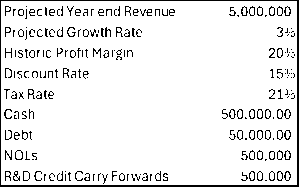
This would produce a simplified DCF that looks like..
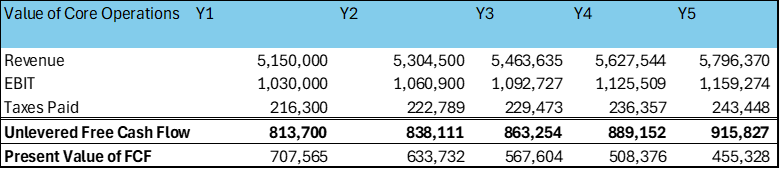
Resulting in an Equity Value of
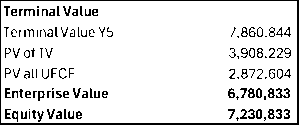
After calculating the NOLs and R&D Credits the buyer will be allowed to use in each year, we find that the present value of the $500,000 in R&D Credits is $331,308. This is added back to the Terminal Value calc and increases the equity value of the business by 5%.
The Bottom Line: While you may not be able to use your R&D Tax Credits right away, they do have a definite value in the future.
Conclusion
In a five- or ten-year modeling exercise calculating the value of these tax attributes can become complicated and the items discussed above are only small pieces of the puzzle. The team at ATS is ready to help both business owners and buyers determine how these tax elements will work in a transaction.
Interested in seeing what your R&D Tax Credits are Worth? Check out our R&D Credit Valuation Tool