
The Key Mistakes That Put R&D Tax Credit Claims at Risk
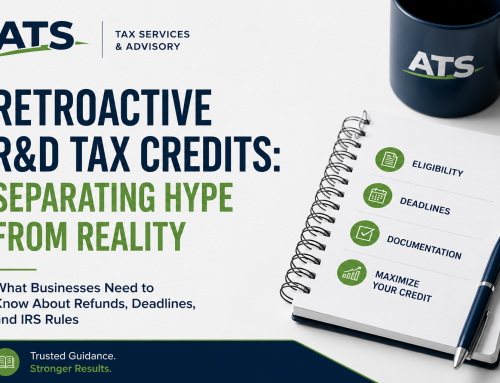
As the R&D Tax Credit becomes increasingly popular, we are noticing a pattern of key mistakes that may put claims at risk. R&D Tax Credit providers are popping up everywhere and businesses are being told that they can unlock significant savings, sometimes reaching six figures, with minimal effort and generous lookback periods.
This message is not entirely wrong. But there is a growing gap between what is being promised and what is being properly substantiated.
After more than 15 years working on R&D tax credit studies, a clear pattern is emerging.
As more providers enter the market, claim quality is declining.
The issue is no longer missed opportunity. It is audit exposure.
Here are the four most common mistakes showing up in recent R&D tax credit claims and why they matter.
Treating Form 6765 Like It Has Not Changed
The IRS fundamentally reshaped Form 6765 in 2024. Yet many claims are still being prepared as if nothing happened.
That is a problem.
Previously, it was often sufficient to provide high-level calculations and summary figures. Today, the IRS requires far more operational detail, including:
- Number of business components
- Officer wage allocations tied to R&D
- Controlled group status
- Acquisition-related disclosures
This is not a compliance box-checking exercise. It requires a working understanding of how the business actually operates throughout the year.
When providers shortcut this process, errors creep in. Not just technical errors, but narrative inconsistencies that can unravel a claim under scrutiny.
Ignoring the Funded Research Trap
Most providers can recite the four-part test:
Business component, technological in nature, elimination of uncertainty, and the process of experimentation.
But many stop there.
The reality is that a fifth, equally critical hurdle often determines eligibility: the rules governing funded research.
If a company performs R&D under contract or grant, the credit may be limited or entirely disallowed depending on who bears financial risk and who retains rights to the results.
Here is the complication.
The tax code does not clearly define what “funded” means.
That ambiguity has been shaped through decades of tax court decisions. Applying those rulings requires more than surface-level knowledge. It requires case law fluency and contract-level analysis.
Too many claims assume eligibility without doing that work.
Leaving Money on the Table or Misreporting It
Ironically, some of the weakest claims are also the most incomplete.
We routinely see studies that rely heavily on internal surveys, asking business owners or managers to estimate R&D costs. The result is predictable:
- Key wage categories are missed
- Contractor costs are inconsistently captured
- Supply and material expenses are underreported or overreported
This is not just about maximizing the credit. It is about accuracy.
A properly executed study requires deep operational diligence, not just questionnaires. Without it, claims are either understated, leaving money behind, or inconsistently documented, creating audit risk.
Copy-Paste Narratives That Will Not Survive an Audit
Perhaps the most concerning trend is the rise of generic, boilerplate reports.
Many R&D studies today read like lightly edited excerpts from the tax code, long on definitions, short on substance.
That approach fundamentally misunderstands what matters in an audit.
The IRS does not need to be told what the law says. They already know.
What they are evaluating is far more specific:
Does this company’s actual work meet those legal standards?
That requires:
- Project-level explanations
- Clear articulation of technical uncertainty
- Evidence of experimentation and iteration
Without that, even a technically valid claim can fail under review.
The Bottom Line
The surge in R&D tax credit marketing has made the incentive more visible, but not necessarily more reliable.
There is truth in the promise. Many businesses do qualify, and the financial benefits can be substantial. But there is also a risk in the way those claims are prepared.
The difference comes down to rigor.
A defensible R&D tax credit claim is not just a calculation. It is a fact pattern built on technical understanding, legal interpretation, and operational evidence.
Anything less is a liability waiting to surface.
If you are evaluating an R&D credit or questioning one that has already been prepared, it is worth working with a provider that understands not just the opportunity but also the scrutiny that comes with it.